Sacred Birth Pilgrimage: Womb Sites of the United States Part 1
A Reverent Journey for Conception, Pregnancy, Postpartum, and Loss
There are moments in a woman’s life when time bends. It can certainly be found when trying to conceive, carrying life, recovering after birth, and mourning what did not stay.
Across cultures and eras, people have turned toward the land during these thresholds for wisdom and holding. Mountains, springs, caves, and mounded earth have long served as witnesses to blood, prayer, grief, and arrival. The land remembers.
Some of us are called to pilgrimage: to walk slowly, listen deeply, and allow certain places to speak and mirror what is happening within.
All sites named here are offered with reverence for the Indigenous peoples whose lands they are, whose cosmologies predate modern spiritual language, and whose relationships to these places are living. If you visit, please go gently without taking. Just listen to the ancestors of these lands.
What Makes a Place Sacred to Birth?
These sacred sites often share common qualities:
They resemble the womb—enclosed, warm, dark, or fertile
They involve water, earth, or stone shaped throughout time
They mark celestial cycles tied to fertility and blood
They were places of gathering, prayer, seclusion, or healing
Before You Go: Know Whose Land You Are On
Before visiting any sacred site, learn whose land you are entering.
Every place named here exists on Indigenous land with living peoples, languages, and responsibilities attached to it. These are not abandoned sites of a distant past. They are part of ongoing relationships between land, culture, and community.
To prepare:
Look up the Indigenous nation(s) connected to the land you plan to visit
Learn how that nation refers to the place, if that information is publicly shared
Read about any access guidelines, restrictions, or requests for visitors
Consider supporting the tribe directly through donations, land taxes, cultural centers, or educational resources
A simple acknowledgment is an orientation of respect. You might say something as simple as: I am a guest here. I will visit with care.
This isn’t to guilt you or create perfection. You’re building a relationship with the land (even if for a day), it’s people, and the ancestors of this land. We don’ t arrive without impact. When we know whose land we are on, our presence changes.
Serpent Mound (Ohio)
Fertility, Cycles, Cosmic Conception
Carved into the earth over a millennium ago, Serpent Mound coils across the land in the unmistakable form of a snake swallowing an egg. Across cultures, the serpent represents life force, renewal, and the intelligence of the body. The egg represents potential, gestation, and becoming.
This site aligns with solar and lunar events, suggesting ceremonial awareness of time, fertility, and cosmic rhythm. It is not difficult to imagine this place holding prayers for conception, for safe passage, for life continuing.
If you visit while trying to conceive or pregnant, walk slowly. Let your breath match the curve of the land. Consider what you are carrying, physically or emotionally, and what it means to trust the cycle.
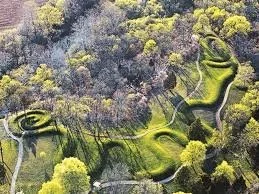
Image from Ohio state parks.
Cahokia Mounds (Illinois)
Earth Wombs, Ancestral Motherhood, Blood Mysteries
Once the largest pre-Columbian city north of Mexico, Cahokia was a center of life, agriculture, and ceremonial gathering. The mounds themselves are raised earth.
Many scholars believe women held central roles in the spiritual and agricultural life of Cahokia. These mounds can be understood as earth wombs: places of gestation, offering, and remembrance.
For those postpartum or grieving loss, this is a place to sit with what has already been born, whether a child, a version of yourself, or a dream that requires release.
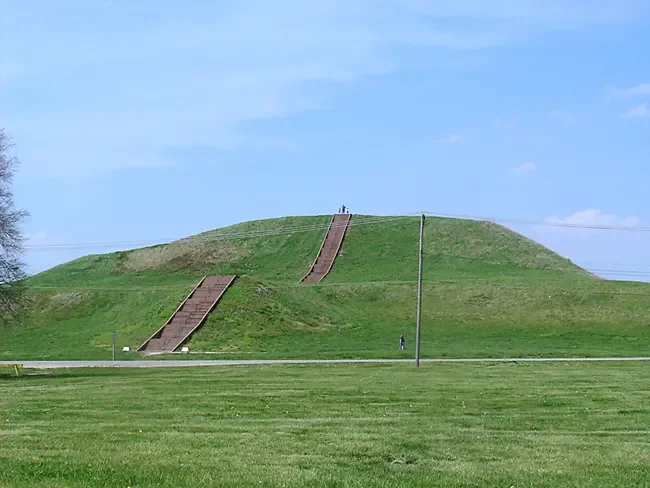
By Skubasteve834 - EN.Wikipedia, CC BY-SA 3.0, https://commons.wikimedia.org/w/index.php?curid=3019271
Chaco Canyon (New Mexico)
Matrilineal Order, Cosmic Timing, Ancestral Continuity
Chaco Canyon was a center of complex Puebloan culture, marked by sophisticated architecture aligned with solar and lunar cycles. These structures are cosmological.
Matrilineal lineage shaped social and spiritual life. The moon, often thought of as keeper of menstrual and fertility rhythms, was one of several celestial spirits honored through careful design.
For pregnant visitors, Chaco invites contemplation of lineage: who you come from, and what continues through you.
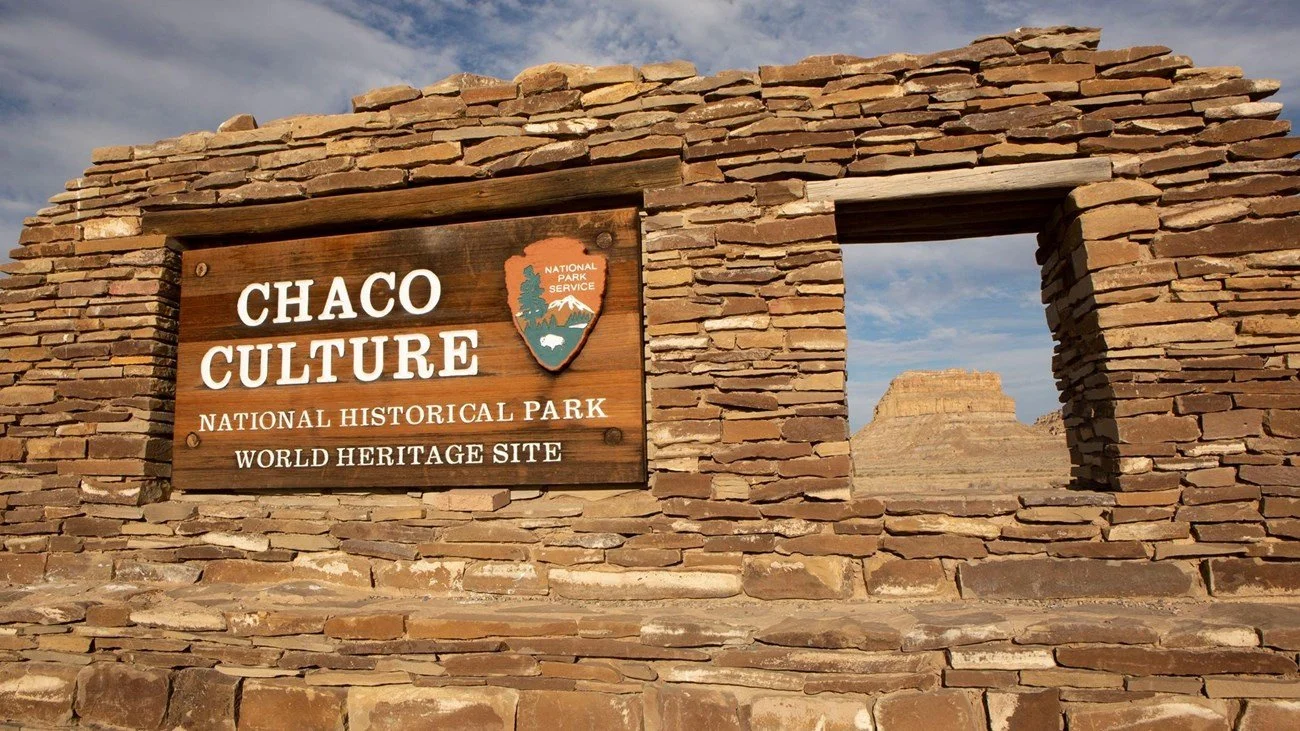
Image from NPS
Mount Shasta (California)
Mother Mountain, Gestation, Vision
Long held sacred by Indigenous nations, Mount Shasta has also become layered with contemporary spiritual interpretations. I think it’s important to distinguish personal meaning from cultural origin.
As a landscape, the mountain unmistakably reads as maternal. Many experience it as a place of deep introspection.
If you come while navigating fertility or loss, let the mountain remain what it is. Just be present. This is perfect.
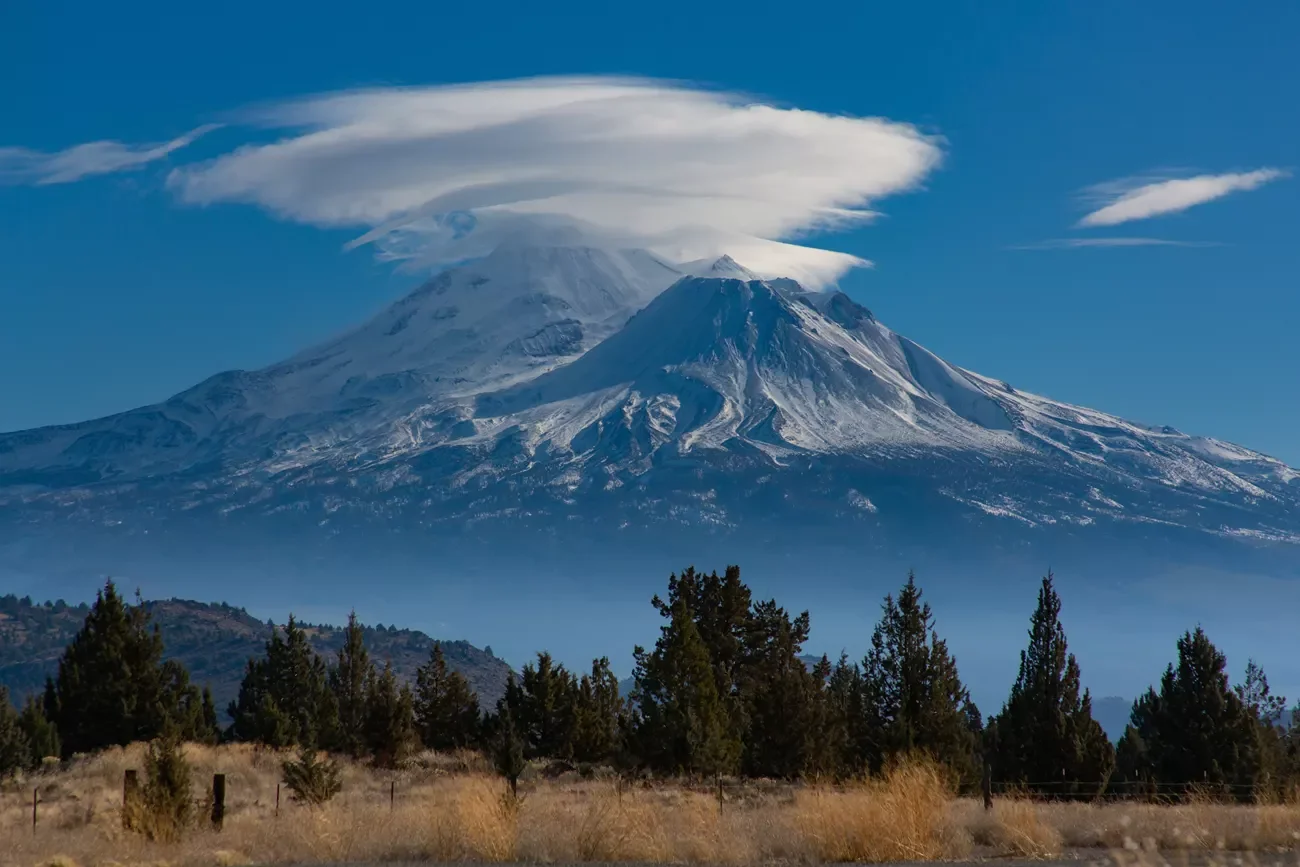
Image from NPS
Caves of the Southwest (Arizona & Utah)
Womb Space, Initiation, Descent
Caves have long been associated with rites of passage—menarche, pregnancy, and preparation for birth. Darkness, enclosure, and stillness mirror the internal world of gestation. Plus, the whole descent has always preceded emergence.
For women facing fear, transition, or grief, caves remind us that withdrawal is not failure. You are preparing. You need the descent.
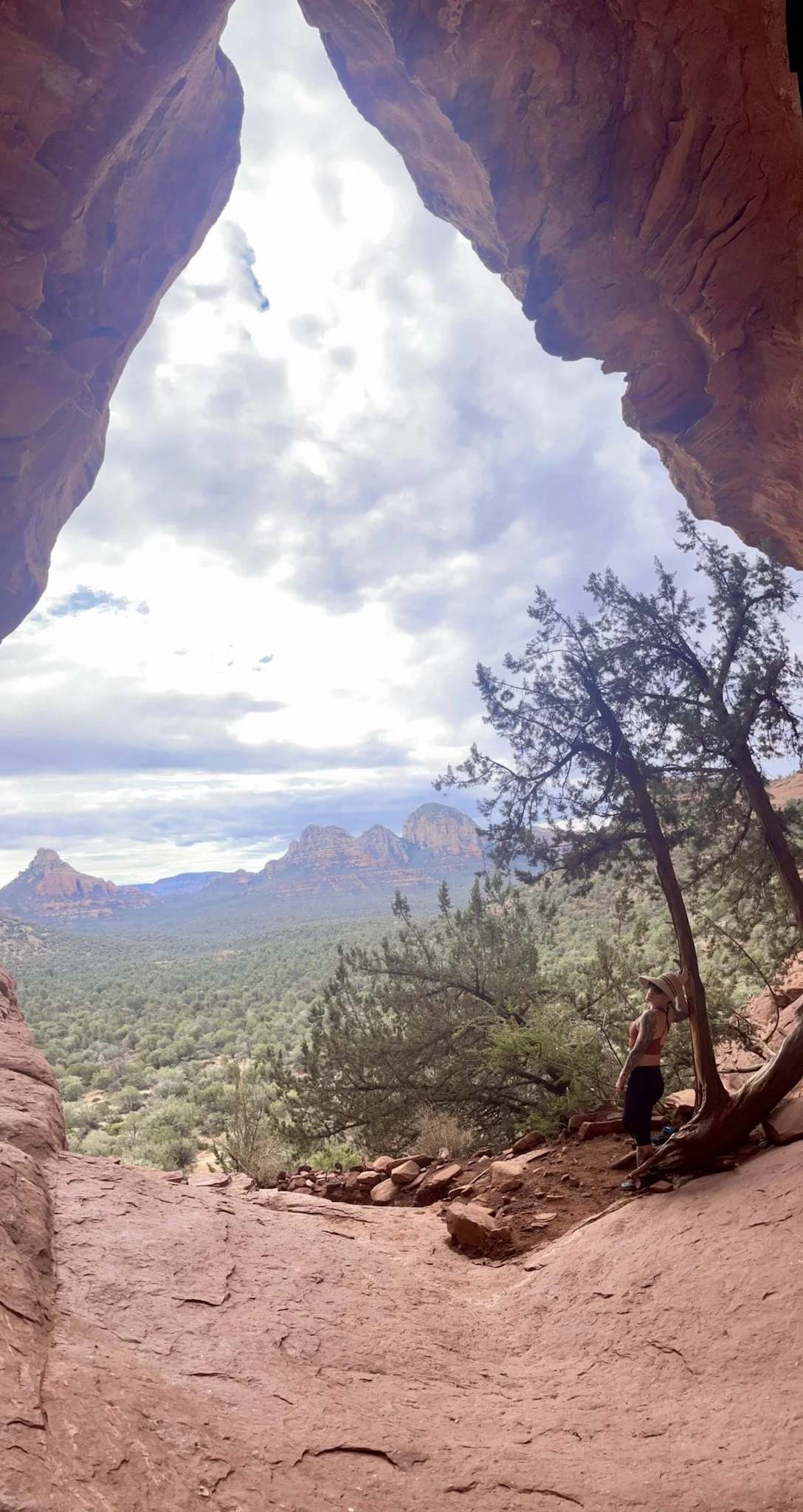
Myself in the “birth cave” at Sedona
Manitou Springs (Colorado)
Fertility Waters, Ancestral Prayer, Blessing
Meaning “Great Spirit,” Manitou Springs has been a gathering place for prayer and healing for generations. Mineral waters were carried away for births and blessing.
This is a place to offer gratitude for what is present, and for what has passed through you.
Pilgrimage Without Appropriation
A pilgrimage does not require ritual garments, borrowed prayers, or recreated ceremonies. A pilgrimage is slowing down, listening, consent of the land (including access rules and cultural protections), and a willingness to be changed. Our bodies are not separate from these places. You are also land remembering itself.
A Land Acknowledgment Prompt for Pilgrimage
These prompts are offered as a private orientation. Before you arrive, or when your feet first touch the land, pause. Place a hand on your body and take s few deep breathes. Follow it down to your pelvis.
Reflect on:
Whose land am I standing on?
What peoples have tended, birthed, grieved, and prayed here before me?
What am I carrying as I enter this place?
How do I wish to move so that I do not take more than I give?
If words feel appropriate, you may offer something simple:
I acknowledge that I am a guest on this land.
I honor the people who belong to it.
May I walk gently, listen deeply, and leave no harm in my wake.
Then just listen for a bit. Let the land respond or maybe it will remain silent. This moment shows humility and reverence.
You Are Also A Sacred Site
These places exist because women have always known where to go when life feels so heavy or to be celebrated at the threshold. This is so lovely but let me remind you, you carry a deep sacred site, your womb. And it is a landscape worthy of reverence.
May the land bring you remembrance.